
Proposition 218 Explained

Approved by California voters in November 1996, Proposition 218 represented a new approach to limiting local government revenue powers. While prior actions originating with Proposition 13 of 1978 concentrated mainly on property tax, Proposition 218 changed the focus to two other revenue sources—assessments and fees, and essentially restricts any increase in assessments and fees to the actual cost of providing those services. Proposition 218 also requires government agencies and utilities to notify property owners of proposed changes to rates for services via a written notice sent 45 days prior to a scheduled public hearing regarding proposed changes.
If the District’s Board approves to start the Proposition 218 process a part of a proposed water rate increase, written notices will be disseminated to our customers as required by law. These notices will contain all the information you need to know, including a summary of the proposed changes and a description of the procedure (i.e. the how, when and where) to allow you to file an objection.
Applicable New State Law
In January, three new bills (AB 1827, AB 2257, and SB 1072) signed by the Governor have now become law:
-
AB 1827: Meter Charges & Peaking
AB 1827 affirms the long-standing practice of using meter size and peak water use to allocate certain water service costs to customers. This law codifies that the incrementally higher costs of water service associated with higher water usage demands, the maximum potential water use, or projected peak water usage are reasonably related to water service and can be factored into water rates.


-
AB 2257: Pre-Adoption Objections to Rates
Water agencies historically have been repeatedly sued by individuals who object to a water rate structure only after the rate has been adopted, and after customers have already been charged. These objections are often not known to the agency until the lawsuit is filed. To ensure that agencies have an opportunity to respond to objections (and fix any errors) before a rate is adopted, AB 2257 authorizes water agencies to create official procedures requiring an objection prior to adoption of that rate to prevent unanticipated lawsuits. Now, only those people who filed an objection may legally challenge that rate. This provides a meaningful opportunity to resolve ratepayer objections before resorting to litigation.
-
SB 1072: Surplus Funds to Reduce Future Fees
Low-water users will especially benefit from SB 1072 which requires any charges exceeding the cost of the services to be used to defray future costs. The Constitution requires public water agencies to limit their charges to each customer’s proportional costs of the services received but does not specify what must be done with excess funds. Because public agencies make no profit, any overages are generally deposited in the general fund or reserve fund and then used as a system-wide offset or credit against future rates.
Consistent with that approach, SB 1072 requires that excess fees remain in the enterprise fund and defray the costs of future services and not get returned to high-water users. High-water users have sued water agencies for refunds, claiming that they should not pay their share of larger facilities needed to serve their larger demand. This would result in low-water users subsidizing the cost of those facilities. SB 1072 clarifies that refunds are only allowed if provided for by a statute – such as refunds for billing errors.
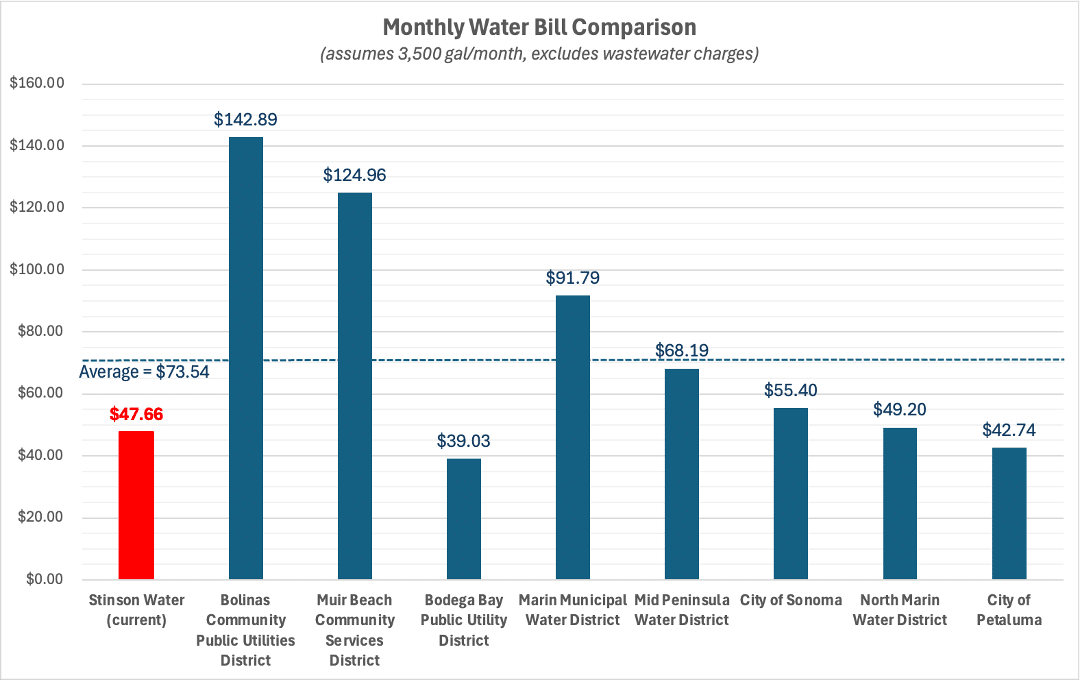
The District’s Water Rate Is One of the Cheapest in the Area*
Document Request
Submit form to request a digital copy