
Adopted on June 20, 2026 - Ordinance No. 2026-01
“The purpose of this Code is to implement provisions of Article 10, Chapter 1, Part 5, Division 12 of the “Water Code of the State of California” (Section 31145 et seq.) and more specifically to establish regulations to control and enhance the quality of the ground and surface waters of the District by regulating, prohibiting, or controlling the discharge of pollutants, waste, or any other materials into the ground or surface waters or the contiguous water bodies of the District.”
Chapter 4.01: ADMINISTRATIVE PROVISIONS
4.01.010 Scope
This Code establishes the terms and conditions under which all privately owned onsite wastewater treatment systems (OWTS’s) within the District’s jurisdictional boundary will be designed, constructed, owner-operated, and regulated by the District.
4.01.020 Title, Citation and Reference
The Title IV – Onsite Wastewater Treatment Management Code of the Stinson Beach County Water District may be cited and will be referred to herein as “Code”.
4.01.030 Application
This Code shall apply to all discharge and potential discharge of Wastewater into and/or onto soils and into waters within the District’s jurisdictional boundary.
4.01.040 Disposal of Waste
No person shall place, deposit, or permit to be deposited upon, within or under, public or private property within the District in a manner not in conformance with all federal, state, and county laws, ordinances, and regulations or in an unsanitary manner, any human or animal excrement; garbage or offal; residential, commercial, agricultural or industrial wastewater; or other waste which may degrade the quality of ground and/or surface waters.
4.01.050 Separate OWTS Required for Each Parcel
Unless otherwise approved by a Variance, no OWTS shall be constructed to serve more than one parcel or shall be constructed on a separate parcel from the structure(s) served unless the parcels are merged.
4.01.060 Prohibition of Graywater Systems
Use of separate systems designed to specifically treat Graywater is expressly prohibited. All Graywater shall be plumbed directly into the parcel’s septic tank for further treatment by the parcel’s permitted OWTS.
4.01.070 Outdoor Showers
All outdoor showers used for Bathing are considered Graywater Systems, shall be plumbed into the parcel’s permitted OWTS, and shall contribute 60 gallons per day to the design flow of the OWTS. All outdoor showers plumbed into the parcel’s permitted OWTS shall be fitted with a removable cover or plug to prevent precipitation from entering the drain when not in use. All showerheads, including rain showers and hand-held showers, shall conform to the current EPA WaterSense Specification for Showerheads (Version 1.1, and as updated), with a maximum flow rate of 2.0 gpm.
4.01.080 Property Alternations or Improvements
All building permit applicants to the County for the purpose of making any alterations or improvements to a property, making application for the building of a new structure, or changing use of the property, shall demonstrate that the existing or proposed new OWTS, in its entirety, meets all the requirements set forth in this Code following construction of said alterations or improvements.
- The additional following criteria shall also be met:
- Property owner must currently be in possession of a valid wastewater discharge permit; and
- The existing OWTS must have been inspected by the District within the previous six months and have no outstanding Maintenance orders; and
- If the footprint of a building or structure is to be enlarged or if a new structure is to be added, demonstrate that sufficient space exists on the parcel for an OWTS that complies with this Code.
4.01.090 Fees and Charges
Pursuant to Article 10, Chapter 1, Part 5, Division 12, section 31145 et seq. of the “Water Code of the State of California, the Board may, by resolution, establish and/or alter fees and charges related to receive applications, hold hearings, review plans and specifications, perform inspections, issue permits, and to perform any other service related to maintaining and operating the onsite wastewater management program for any OWTS and/or property within the District’s jurisdictional boundary. No OWTS shall be constructed, have Maintenance performed, or be operated until all such fees have been paid.
The District may process payment for any fee or charge on the customer’s unified bill with water service billing. Collection, penalties for late payment, and other procedural matters related to billing shall be the same as those provided by the District for water service. Any premises where discharge permit fees or other fees and charges established are delinquent, shall be subject to Enforcement as specified in Chapter 4.04 of this Code.
All prescribed OWTS fees are the responsibility of the property owner.
4.01.100 OWTS Inspection
All OWTS’s within the District’s jurisdictional boundary are subject to regular inspection as determined by District staff or General Manager. Upon notification from the District, owners are required to have all elements accessible for inspection, including access to the septic tank riser, pump/recirculation tank riser, diversion valves, pretreatment system, dispersal field(s), alarms, panels, monitoring wells, and pumps. All riser lids shall weigh less than twenty-five pounds. Prior to inspection, owner shall clear all ground cover, plantings, debris and similar around tank risers back to a minimum distance of 24 inches. All gates shall be unlocked and padlocks on panels or lids shall be removed prior to the inspector’s arrival. All hatches must be easily removable. Deck hatches that weigh more than twenty-five pounds must be removed and if screwed down, all screws shall be removed prior to the inspection. Any obstructions, such as monuments and birdbaths that limit access must be removed. Pets must be confined during the inspection.
The scope of a OWTS inspection shall include, but is not limited to:
- Verification of system component locations; and
- Diversion valve operation, pump runs, float operation and valve operation; and
- Verification of installation of mosquito abatement equipment including screening of all waste vents and proper sealing of all septic tank risers; and
- Measurement of scum and sludge depth; and
- Inspection for possible ponding, standing water, breakout, and noticeable odors; and
- Examination of tank structure, pumps, and floats; and
- Performance of hydraulic loading to verify the timing of dispersal field hydraulic acceptance; and
- Monitoring of pump timers.
- Any other item deemed reasonably necessary by the General Manager and/or District inspector.
All necessary inspection shall be performed to the satisfaction of the inspector to ensure the OWTS is operating pursuant to this Code. If the District’s inspection cannot be performed due to inaccessibility of the property and/or OWTS, the District shall reschedule the inspection one time at no cost. Any subsequent rescheduled inspections shall result in a $50.00 fee per incident. After the third attempt, the OWTS shall be considered a Nuisance subject to enforcement action as prescribed in Chapter 4.04 of this Code.
Upon completion of a periodic inspection, the District shall issue a Notification of Completed Inspection and/or Maintenance Order listing all required corrective actions, if any. The property owner shall comply with all conditions within the required timeframe indicated on the Maintenance Order.
4.01.110 Mosquito Infestation
Mosquito infestation in any component of an OWTS shall be considered a Nuisance and therefore subject to the enforcement provisions as stated in Chapter 4.04 of this Code. Owner shall be required to contact the Marin/Sonoma Mosquito and Vector Control District to have any infestation abated prior to the District scheduling or rescheduling an inspection. Use of any toxic insecticide or other harmful chemicals in any OWTS component is expressly prohibited.
4.01.120 Tampering Prohibited
To carry out technical and other investigations, examinations, or tests of surface water and groundwater within and passing through the District, the District may establish and install equipment, test wells, and other devices on public property and, with the permission of the owner, on private property. No person shall tamper with, remove, or modify such equipment, test wells, and other devices or otherwise interfere with the conduct of such investigations, examinations, or tests.
4.01.200 Other Requirements
Nothing within this Code shall be construed to reduce, impede, or otherwise interfere with any additional requirement that may be imposed by any law, ordinance, rule, or regulation of a legally constituted authority having jurisdiction over such matters.
4.01.300 Amendment
This Code shall be reviewed regularly by staff, and as necessary by the District Wastewater Committee, to incorporate applicable changes and amendments deemed by the District to be necessary. The Board shall complete a full review of this Code at no less than five-year intervals. This Code may only be amended by Ordinance of the Board.
4.01.400 Severability
If any section, or portion thereof, of this Code is found by a court of competent jurisdiction to be invalid or unconstitutional, all other provisions shall remain in full force and effect.
Chapter 4.02: DEFINITIONS
4.02.010 Terms Defined by Federal and State Agencies
Terms which are not specifically defined in this Code shall be as defined in:
- The most recent edition of the “Minimum Guidelines for the Control of Individual Wastewater Treatment & Disposal Systems of the California RWQCB, San Francisco Bay Region” (hereinafter referred to as Minimum Guidelines); or
- The most recent edition of the “Design Manual: Onsite Wastewater Treatment and Disposal Systems”, (hereinafter referred to as Design Manual), published by the United States Environmental Protection Agency; or
- The most recent edition of the CPC, as published by the International Association of Plumbing and Mechanical Officials.
4.02.100 Alternative System
Any OWTS design, in part or in whole, that does not conform, except approved Variances, to the provisions of Chapter 4.14 of this Code.
4.02.101 ASTM
ASTM International is a globally recognized organization for materials, products, systems, and services testing standards.
4.02.102 Bathing
Use of any soap, shampoo, conditioner, body wash, or any other cleaning agent, surfactant or the like while using an outdoor shower shall be considered Bathing. Use of an outdoor shower without the use of said products shall not be considered Bathing.
4.02.103 Board
The Board of Directors of the Stinson Beach County Water District.
4.02.104 CBC
An acronym for the “California Building Code”.
4.02.105 CPC
An acronym for the “California Plumbing Code”.
4.02.106 CBOD5
An acronym for “Carbonaceous Biological Oxygen Demand”. The subscript “5” refers to the composite CBOD test results after 5 days, per NSF Standard 40.
4.02.107 CEQA
An acronym for the “California Environmental Quality Act”.
4.02.108 Change of Use
Any difference in use of the property resulting in a change in either the quality and/or quantity of wastewater disposed in an OWTS such that the existing system may be inadequate for the use and/or no longer compliant with this Code.
4.02.109 Chemical Toilet
A self-contained temporary toilet which utilizes chemicals to mask odors. Also referred to colloquially as a “port-a-potty”.
4.02.110 County
The County of Marin, California, as applicable.
4.02.112 Cut or Embankment
A cut or an embankment is all cuts and embankments, whether or not retained by a structure, as defined in the Minimum Guidelines, which cut or embankment is greater than 24 inches in vertical height.
4.02.113 Deputy
Any District employee designated by the General Manager to assist in the implementation of this Code.
4.02.114 Designer
Any licensed professional engineer authorized by the State of California to design onsite wastewater treatment systems.
4.02.115 Discharge Permit
A recorded document that authorizes operation of an OWTS in accordance with this Code.
4.02.116 Dispersal Field
A system of trenches or beds that distribute treated sewage effluent for absorption into the soil. "Soil absorption system" as used in the Minimum Guidelines, "disposal field" as used in the CPC, and "dispersal field" as used herein shall all be considered synonymous.
4.02.117 District
The Stinson Beach County Water District, also referred to as Stinson Water.
4.02.118 District Engineer
Any professional engineer licensed by the State of California whom the Board has deputized to act on the District’s behalf to implement this Code. The District Engineer may be either:
a) The General Manager, if so licensed; or
b) A contracted professional engineering consultant, reporting directly to the General Manager.
4.02.120 Downslope Property Line
A property line of the subject property where the ground on the adjacent property slopes downward from that property line.
4.02.125 Dual Dispersal Fields
An OWTS that includes two complete dispersal fields connected by an accessible diversion valve intended for alternating use.
4.02.130 Existing Use
A condition where the quality and quantity of wastewater disposed in an OWTS is unchanged from that which is indicated on the Discharge Permit.
4.02.133 Failed System
Any OWTS which is discharging or is otherwise in violation of this Code and/or whose components do not meet the specifications of this Code.
4.02.135 Failed System Citation
The District’s primary tool for enforcement. A Failed System Citation is issued after a Discharge Permit has been revoked, and the Citation is recorded at the office of the Marin County Recorder. A Discharge Permit will be reissued and recorded at the office of the Marin County Recorder upon final resolution of the citation.
4.02.136 FOG
An acronym for “Fats, Oils and Grease”.
4.02.137 General Manager
The Board-appointed General Manager for the District.
4.02.140 Graywater
Untreated wastewater which has not been in contact with toilet waste and/or drainage. Graywater includes, but is not limited to drainage from indoor or outdoor bathtubs, indoor or outdoor showers, indoor or outdoor wash basins/sinks, dishwashers, laundry washing machines/tubs (except laundry water from soiled diapers), or an equivalent discharge. Graywater shall be considered Wastewater and therefore subject to all discharge permitting and limitations as described herein.
4.02.143 Grease Interceptor
An external, in-ground, watertight receptacle/chamber, designed and constructed to intercept fats, oils, and grease upstream of the septic tank and/or any supplementary treatment tank.
4.02.145 Groundwater
Any subsurface body of water.
4.02.147 Habitable Space
The total interior space designed to be or is useable for living (which includes but is not limited to: lounging, sitting, working, sleeping, exercising, eating, drinking, cooking or bathing) within all structures serviced by the OWTS. Habitable space shall be measured from the interior wall face and reported in square feet.
Most space within any structure shall be deemed habitable space. Non-habitable space generally includes rooms or enclosed spaces that have no plumbing and/or are neither designed nor intended for human occupancy. These include but are not limited to the following:
- Closets, less than or equal to 30 square feet
- Storage rooms/pantries
- Garages used solely for vehicular parking or storage
- Unfinished basements
- Mechanical equipment or utility rooms/closets having no plumbing
- Stairwells, except for the ground floor landing for each stairwell
- Non-habitable accessory or storage structures
- Any unimproved space that does not meet the minimum height standard for habitable space according to the CBC.
4.02.150 Maintenance
Repairing or replacing any non-treatment components of an OWTS, pumping liquid and/or solids from or otherwise cleaning septic tank(s) and/or Grease Interceptor(s), and/or in-situ cleaning/jetting of conveyance pumps and piping. All Maintenance shall require a District Maintenance Permit.
4.02.153 MPN
An acronym for “Most Probable Number”. This is an estimate of the actual number of colony-forming bacterial units, as described in the “Standard Methods for the Examination of Water and Wastewater”.
4.02.154 NEMA
An acronym for “National Electrical Manufacturers Association”.
4.02.155 New OWTS Construction
New OWTS Construction shall be defined as, but not limited to:
- Complete replacement of an existing OWTS that either in part or in whole, does not meet the requirements of this Code or has failed and cannot be corrected through Maintenance; or
- Partial replacement of an existing OWTS, subject to approval of a Variance request per Chapter 4.08 of this Code, that either in part or in whole, does not meet the requirements of this Code or has failed and cannot be corrected through Maintenance; or
- Required construction of a completely new OWTS due to:
- Increasing habitable space within or in addition to any existing structure(s) served by an existing OWTS whose treatment capacity has been exceeded with said building improvements, as specified by this Code; or
- Construction of any new structure having habitable space, as specified by this Code; or
- Any change or alternation in footprint to an existing structure served by an existing OWTS whose design does not meet all requirements set forth in this Code; or
- Any change or alternation in use of an existing structure served by an existing OWTS whose design does not meet all requirements set forth in this Code.
All New OWTS Construction shall be subject to design review and if approved by the District, require a District Construction Permit.
4.02.157 Non-Treatment Component
A component of an OWTS that is not part of the treatment process, including but not limited to: risers, septic tank lids, Tight Lines, inlet tees, outlet tees, diversion valves, and non-perforated pipe.
4.02.158 NSF
An acronym for the “National Sanitation Foundation”, a globally recognized organization for public health standards.
4.02.159 Nuisance
Any condition constituting a potential threat to the health and safety of the public or may cause harm to the riparian environment, including but limited to:
- Any OWTS operating in violation of this Code; or
- Any OWTS operating in a manner not consistent with its design, e.g. frequently exceeding the design flow as stated on the Discharge Permit; or
- Any OWTS or OWTS components that do not conform to this Code without an approved Variance; or
- Any unpermitted or illegal discharge of Wastewater into ground or surface waters located within the District’s jurisdictional boundary; or
- Repeated denial of access to an OWTS by the District; or
- Failure to sufficiently complete any specified Maintenance order issued by the District within the timeframe indicated; or
- Failure to comply with any written instruction or remedy as required by the District, within the timeframe indicated.
4.02.160 Overall Percolation Rate
The overall percolation rate shall be determined by averaging all the percolation rates calculated as described herein for each proposed dispersal field.
4.02.161 OWTS
Acronym for “Onsite Wastewater Treatment System”. An OWTS shall include all devices, parts, elements, structures, and/or components, located between the building(s) served and the point of discharge into soil.
4.02.162 Pretreatment Device
A treatment component that provides advanced secondary treatment and nutrient removal of septic tank effluent. Examples include recirculating sand filters or recirculating textile filters.
4.02.163 RSF
An acronym for a “Recirculating Sand Filter”, a standard pretreatment device.
4.02.164 RTF
An acronym for a “Recirculating Textile Filter”, a standard pretreatment device.
4.02.165 RWQCB
An acronym for the “Regional Water Quality Control Board”, San Francisco Region. Also may be referred to as “Regional Board”.
4.02.167 Saturated Soil
Soil that has reached its moisture holding or "field" capacity.
4.02.170 Setback
The horizontal straight-line distance measured between the nearest points or edges of specified structures, features, OWTS components, and/or property lines.
4.02.173 Soil Depth
The combined thickness of soil layers which are porous enough to accept effluent soil absorption systems. Soil depth is measured vertically from the surface to bedrock, hardpan, or an impermeable soil layer.
4.02.174 Special Flood Hazard Area
Zones A, AE, AH, AO, AR, A99, V, and VE as shown in the most current FEMA Flood maps for the Stinson Beach area.
4.02.175 Squirt Height
The height of flow measured during a squirt test. Squirt height shall be measured from centerline of the dispersal field lateral. For 1/8-inch orifices, the minimum required squirt height shall be 5 feet. For 3/16-inch orifices, the minimum required squirt height shall be 3 feet. For 1/4-inch orifices, minimum required squirt height shall be 2 feet.
4.02.176 Squirt Test
A test to determine Squirt Height that is performed during a final construction inspection to determine that the OWTS has sufficient pressure and flow to function properly. A squirt test will be performed on each dispersal field, after the system has been balanced for flow.
4.02.177 Standard System
Any OWTS designed per Chapter 4.14 of this Code.
4.02.179 Temporary Use
Active use for less than six consecutive months, unless otherwise superseded by a District permit or by the General Manager as needed for design of a new OWTS.
4.02.180 Tight Line
The section of pressurized pipeline between the septic tank, pretreatment unit, and dispersal field, but not inclusive of any piping within the pretreatment unit or dispersal field.
4.02.182 TKN
An acronym for “Total Kjeldahl Nitrogen”. This is a measure of total organic nitrogen and ammonium present.
4.02.183 TSS
An acronym for “Total Suspended Solids”.
4.02.185 Treatment Component
An element of an OWTS specifically intended or designed to reduce the contaminants in wastewater prior to its combining with groundwater.
4.02.187 Unstable Landform
An area showing evidence of mass downslope movement.
4.02.189 Variance
A request to deviate from the design standards set forth in this Code. All Variance requests are subject to the provisions of Chapter 4.08 of this Code.
4.02.190 Wastewater
All waste, substance, liquid or solid, which contains or may be contaminated by human waste or other substances that may be injurious or dangerous to human health and/or the environment either directly or indirectly.
4.02.191 Watercourse
A definite, open channel with bed and banks within which natural water flows either perennially, ephemerally, or intermittently including overflow channels contiguous to the main channel. A watercourse shall include both natural and manmade channels, but shall exclude interceptor drains as specified in this Code.
4.02.193 Water Bodies
The Bolinas Lagoon, Seadrift Lagoon, the Pacific Ocean, any wetlands or seasonal wetlands as defined by the U.S. Army Corps of Engineers, or other bodies of water such as ponds or lakes.
4.02.195 Water System
Any water source, water treatment unit, water storage, or water distribution system, or any combination thereof, other than any such water system owned by the District or other public agency.
4.02.197 Well
Any excavation that is drilled, cored, bored, washed, driven, dug, jetted, or otherwise constructed which excavation is intended to locate, extract, monitor or artificially recharge groundwater.
Chapter 4.04: ENFORCEMENT
4.04.010 Prohibition of Code Violations
Pursuant to the provisions of Section 31147 of the “Water Code of the State of California”, violation of any provision(s) of this Code is a Nuisance subject to enforcement and abatement. The procedures for abatement of a Nuisance established in this Code may be used to abate any Nuisance, pursuant to law.
4.04.020 Discharge Permit Requirement
All OWTS’s within the District’s jurisdictional boundary shall have a valid Discharge Permit issued by the District pursuant to this Code and subject to any provisions as identified in any Board resolution associated with that OWTS.
4.04.030 Enforcement and Interpretation by General Manager
The General Manager is hereby authorized and directed to enforce all the provisions of this Code and shall have the power to render interpretations and enforce rules and supplemental regulations to clarify the application of its provisions.
When the conditions that constitute the Nuisance pose an immediate threat to the public peace, health, or safety, or may cause irreparable harm to the environment, the General Manager may immediately abate the Nuisance in lieu of taking other enforcement action and the owner shall be noticed as stated herein.
For purposes of enforcement of this Code, the General Manager and District Engineer shall be public officers as provided in 836.5 of the Penal Code of the State of California.
Any decision made by the General Manager or District Engineer may be appealed directly to the Board as provided herein.
4.04.040 Notice of Enforcement
Notices regarding any enforcement action by the District, including abatement of a Nuisance, shall be sent by certified mail to the property owner(s) at said owner's billing address, according to District records. In the case of abatement proceedings, a copy of such notice shall be posted conspicuously upon the property. Failure of the owner (or any other person to whom notice is given) to receive a notice as specified herein shall not affect the validity of any proceedings conducted pursuant to this Code.
4.04.050 Right of Entry
For regularly scheduled inspections, or when it is necessary to make a special inspection to enforce the provisions of this Code, or when the General Manager or Deputy has reasonable cause to believe that a violation of this Code exists, the General Manager or Deputy may enter upon the parcel and/or building(s) thereon to perform the duties imposed by this Code; provided however, that if such parcel or building is occupied, credentials shall be presented to the occupant and entry requested. If such parcel or building is unoccupied, a reasonable effort shall be made to locate the owner or other person having charge or control of the parcel or building to request entry. Denial of entry constitutes a violation of this Code, and an inspection warrant may be obtained as provided by law or abatement proceedings may commence.
4.04.060 Penalties and Fines
Unless otherwise specified herein, any person violating this Code shall be guilty of a misdemeanor punishable by a fine not to exceed one thousand dollars ($1,000.00) or imprisonment not to exceed 60 days or both. Each day of such a violation shall constitute a separate offense.
4.04.100 Discharge Permit Revocation
A Discharge Permit for any OWTS may be revoked when:
- A Nuisance, as defined herein, exists; or
- Any permit or approval is issued in error, or is found to be based on incorrect information supplied in the application; or
- The General Manager determines that enforcement action is necessary pursuant to this Code.
4.04.110 Failed System Citation
The owner, upon receipt of said notice revoking the Discharge Permit, shall have 15 calendar days to take corrective action or file an appeal. If the owner, upon receipt of said notice revoking the Discharge Permit, neither takes corrective action nor files an appeal, a Failed System Citation shall be issued to the owner and recorded with the County of Marin.
4.04.120 Abatement Proceedings
The owner, upon receipt of said notice of a Failed System Citation, shall have 15 calendar days to take corrective action or file an appeal. If after 15 calendar days of issuing a Failed System Citation or as otherwise determined, the General Manager shall issue a notice directing the owner or the owner’s authorized agent to appear before the Board at a stated time and place at the next regular Board meeting which falls at least 10 calendar days after the date of the issued notice to show cause why the Board should not order the Nuisance abated.
At the time fixed in the notice, the Board shall hear the testimony of all competent persons desiring to testify respecting the condition constituting the Nuisance. At the conclusion of the hearing, which may be continued, the Board shall by resolution declare its findings. If the Board finds that sufficient evidence exists to support a determination that a Nuisance exists, the Board may order the General Manager (1) to terminate water service to prevent further discharge of Wastewater, or (2) to abate the Nuisance by other means. The General Manager may submit the estimated cost to abate the Nuisance by other means and any other pertinent information to the Board. The General Manager may direct any District employee, contracting agent, or other representative to enter upon the private property in a manner consistent with Section 202c of the Uniform Building Code for purposes of abating the Nuisance.
A copy of the signed resolution directing abatement of a Nuisance shall be sent to the property owner within 7 calendar days after the hearing. Owner shall be responsible for all costs associated for abatement of the Nuisance.
4.04.130 Owner Request for District to Abate a Nuisance
At any time following receipt of the notice of abatement proceedings, the owner may request the District to abate the Nuisance pursuant to the provisions of Section 31148 of the “Water Code of the State of California”. The District and the owner may enter into agreements effecting such abatement.
4.04.200 Stop Orders
Whenever any work being done to the property or OWTS is contrary to the provisions of this Code or other pertinent laws or ordinances implemented through the enforcement of this Code, the General Manager may order the work stopped by notice in writing to any such person(s) engaged in doing or causing such work to be done, and any such person(s) shall forthwith stop such work until authorized by the General Manager to proceed with the work.
4.04.210 Order to Discontinue Use, Discontinue Discharge, and/or Vacate
Whenever any parcel or building regulated by this Code is being used contrary to the provisions of this Code or is discharging waste in violation of this Code, the General Manager may order such use discontinued, such discharge discontinued, and/or the parcel or building or portion thereof vacated by serving a notice by certified mail to the property owner and posting notice on the property. Such owner shall discontinue the use and/or vacate the parcel or building or portion thereof within the time prescribed within the notice.
4.04.300 Appeal of Determination or Order of General Manager
Orders, decisions, or determinations made by the General Manager relative to the application and interpretation of this Code may be appealed within 15 calendar days from the date of service or notification of said order, decision, or determination. Said appeal shall be in writing, filed with the District, and any prescribed fees shall be paid. The filed appeal shall be essentially in the following form:
- A heading in the words: "Before the Board of Directors of the Stinson Beach County Water District"; and
- A caption reading: "Appeal of [give the names of all appellants participating in the appeal]"; and
- A caption stating the Stinson Beach service address and District account number affected by the determination or order of the General Manager; and
- A brief statement setting forth the legal interest of each of the appellants in the parcel(s) or building(s) involved; and
- A brief description of the specific order, decision or determination appealed; and
- A brief statement in ordinary and concise language of the reasons why it is claimed that the order, decision or determination should be reversed, modified, or otherwise set aside; and
- A brief statement and any supporting documents, in ordinary and concise language, of any material facts claimed to support the contentions of the appellant; and
- A brief statement in ordinary and concise language of the relief sought; and
- The signatures of all parties named as appellants along with their contact phone numbers as well as their email and USPS mailing addresses; and
- The verification (by declaration under penalty of perjury) of at least one appellant as to the truth of the matters stated in the appeal.
The appeal shall be placed as public hearing on the agenda of the next regularly scheduled meeting of the Board following the submission date of the appeal. Written notice of the time and place of the hearing shall be mailed to each appellant by certified mail at least 15 calendar days prior to the date of the hearing. Only those matters or issues specifically raised by the appellant shall be considered in the hearing of the appeal.
Except for Stop Orders and Orders to Discontinue Use, Discontinue Discharge, and/or Vacate, any order, decision, or determination of the General Manager shall be stayed during the pendency of an appeal when the appeal has been properly and timely filed.
The Board, when ruling on an appeal, may not set aside or modify the application of discharge or design standards as provided in this Code, nor may the Board take up any matter more properly considered as a request for a Variance pursuant to Chapter 4.08 of this Code. A decision of the Board regarding an appeal shall be final.
4.04.310 Effect of Failure to Appeal
Failure of any person to file an appeal in accordance with these provisions shall constitute a waiver of the right to an administrative hearing and adjudication of the order, decision, or determination of the General Manager provided that said order, decision, or determination has been rendered in writing and a copy of this appeal process has been provided.
4.04.400 Limitation of Liability
Article 10, Chapter 1, Part 5, Division 12, of the “Water Code of the State of California” (Section 31145 et seq.) imposes upon the District certain duties to protect the quality of the surface waters and ground waters within and passing through the District. The establishment, enforcement, and implementation of this Code are among those duties. Notwithstanding any other provision of this Code or permit issued hereunder, any person discharging waste pursuant to such a permit shall have the obligation to conform to all related laws and regulations of all state and local agencies and such person shall indemnify the District from any and all damages, penalties, or other expenses imposed on, or required, of the District by such federal, state, or local agency due to such discharge of waste. Further, the District's liability, and the liability of its officers and employees, for acts or omissions pursuant to this Code are limited under the provisions of the California Tort Claims Act. Notwithstanding any other provision of this Code, the intent of the Board is that all duties imposed by this Code upon the District and/or any District officer or employee are discretionary in nature. Any suit brought against any officer or employee of the District because of an act or omission of said officer or employee in the establishment of and enforcement of this Code and/or any provision thereof and/or other pertinent laws or regulations implemented through this Code shall be defended by the District until final termination of such proceedings, and any judgment resulting therefrom shall be assumed by the District unless it is determined that said act or omission falls within the categories of conduct specified in “Government Code” Section 995.2 or any successor statute thereof.
Chapter 4.06: PERMITTING
4.06.010 Permit Requirements
Any activities described in this Chapter shall require a permit from the District, full payment of any applicable permit fees, and be subject to the permit requirements as specified herein. Any person who commences any activity described herein without first obtaining the required permit shall be considered a Nuisance and therefore be subject to enforcement and abatement as prescribed by the General Manager in accordance with this Code.
4.06.020 Compliance with CEQA
Compliance with all CEQA requirements shall be the sole responsibility of the property owner. Failure to comply with CEQA shall constitute voluntary withdrawal of any permit application, and/or shall result in revocation of a discharge permit.
4.06.100 Septic Pumping Permit
All septic pumping contractors and/or waste haulers performing any extraction or hauling of septic waste or food waste or grease within the District boundaries shall have an approved septic pumping permit. All septic pumping contractors shall be licensed by the County of Marin pursuant to 25000 et seq. of the Health and Safety Code and shall submit a copy of the current County permit to the District prior to issuance of the septic pumping permit.
Septic pumping permits are valid for 1 year.
4.06.200 Chemical Toilet Permit
Except as specifically provided herein, no person shall use a chemical toilet on any public or private parcel within the District. Such devices may only be used temporarily during construction of a building or other structure, during construction of a new OWTS, or other special use providing a specific public health benefit as determined on a case-by-case basis by the District upon application. Upon filing of a temporary toilet permit application and payment of the prescribed fee at the time of application, a permit for such a device serving a temporary use may be issued provided that the device will be provided, regularly serviced and pumped by a person licensed by the County of Marin pursuant to 25000 et seq. of the California Health and Safety Code.
Chemical toilet permits may be valid for either 7 calendar days, 3 months, 6 months or 12 months, at the discretion of the General Manager.
4.06.210 Village Green Parks Chemical Toilets
Three chemical toilets are specifically permitted for long-term use at the two Village Green Parks. Each unit shall be provided and pumped by a person licensed by the County of Marin pursuant to sections 25000 et seq. of the California Health and Safety Code. Each unit shall be serviced and pumped twice a week. The District shall have the discretion to require the non-operation or removal of either or both units if in the opinion of the General Manager, continued use will create a health hazard or public nuisance. The determination may be appealed to the Board.
4.06.220 Seadrift Community Tennis Courts Chemical Toilet
One chemical toilet is specifically permitted for long-term use near the Seadrift Community Tennis Courts. The unit shall be provided and pumped by a person licensed by the County of Marin pursuant to sections 25000 et seq. of the California Health and Safety Code. The unit shall be serviced and pumped twice a week. The District shall have the discretion to require the non-operation or removal of the unit if in the opinion of the General Manager, continued use will create a health hazard or public nuisance. The determination may be appealed to the Board.
4.06.300 Maintenance Permit
No person shall engage in any Maintenance of an OWTS as defined herein and as prescribed by a District-issued maintenance order or for any other reason without having first obtained a Maintenance Permit. The property owner or designated agent of the property owner shall complete and submit a Maintenance Permit application and pay in full any applicable fees at the time of application. Upon completion of the work, the applicant shall then identify all work actually performed on the original Maintenance Permit application, then certify the work as being completed. All work shall be subject to verification by the District.
A Maintenance Permit shall be valid for 30 calendar days.
4.06.400 Design Permit
All New OWTS Construction shall first require an OWTS Design Permit. The property owner or designated agent of the property owner shall complete and submit a Design Permit application for review and approval, and pay in full any applicable fees at the time of application.
The owner or agent shall, as part of their Design Permit application, indicate whether any Variances are requested and shall also pay in full any additional Variance fees at the time of application.
A Design Permit shall be valid for 24 months from the date of issuance, unless otherwise indicated by the General Manager or Board resolution, and once issued no extensions shall be granted.
In addition, all Design Permit applications shall include the following:
- A summary design letter, signed and sealed by the Designer that includes, but is not limited to:
- Detailed description of the work to be performed, including the type of OWTS proposed, indication of whether the proposed system is standard or an alternative design, and reason for the work; and
- Location of the parcel on which the work is proposed, either by legal description, street address, and/or Marin County Assessor's parcel number; and
- Description of the parcel including its total area, zoning type, and FEMA flood zone; and
- All site evaluation results, pursuant to Chapter 4.12 of this Code, and how the proposed OWTS will be designed to operate in existing soil conditions; and
- Complete list of all structures on the property serviced by the proposed OWTS, the intended the use/occupancy of each, and the total habitable space for each; and
- Design criteria used for the proposed OWTS, including design flow; and
- Anticipated construction schedule; and
- If applicable, a complete list of all Variances requested along with sufficient justification and appropriate responses to all Findings of Fact as required by Chapter 4.08 this Code.
- One full-size (24x36 inch) and one half-size (11x17 inch) sets of project design drawings, signed and sealed by the Designer, which include but are not limited to:
- A vicinity plan showing the property location; and
- An overall site plan at standard engineering scale (e.g. 1 inch = 10 feet) and complete layout of the proposed OWTS along with results of a topographic survey conducted within the last 3 months showing all contours and/or spot elevations on the entire parcel and an indication of the direction and percentage of slope at the proposed dispersal field; and
- Location of all wells, springs, watercourses, water bodies, marsh areas, drainage ditches, channels, cuts, embankments, natural bluffs or unstable land forms on the parcel or within 100 feet of the parcel boundary; and
- Location of all existing and/or proposed structures, fencing, decking, swimming pools, hot tubs, fountains, retaining walls, driveways, sidewalks, boardwalks, any paved areas, concrete foundations, propane tanks, underground utilities, storage tanks (underground and above ground), and all trees with trunks greater than or equal to one inch in diameter on the parcel; and
- Location of all components of any existing OWTS on the parcel; and
- Location of all easements on the parcel and within 25 feet of the parcel boundary; and
- Proposed layout (including dimensions) of the new OWTS; and
- Callouts for setback distances to all components of the OWTS pursuant to Chapter 4.12 of this Code; and
- Typical trench section and any other essential construction details, such as pumps, intercept drains, supplemental treatment units, monitoring wells, etc; and
- Location of individual soil percolation test holes and soil profile holes; and
- Pipe schematic showing all components, pumps and valves of the proposed OWTS; and
- All other system details and construction notes.
- All detailed site evaluation testing results, pursuant to Chapter 4.12 of this Code, signed and sealed by the Designer.
- All calculations, signed and sealed by the Designer, including pump curves and headloss calculations, used to determine sizing of the septic tank, pumps, pretreatment unit (if applicable), dispersal field, and any other special design features.
- Where the proposed dispersal field ground slope of the existing landform exceeds 20%, a geotechnical engineering report, signed and sealed by a registered geologist, demonstrating that the proposed design will not create a public health hazard or jeopardize the building site or contiguous properties. It shall not be permissible to re-grade the existing landform to achieve a reduction in ground slope.
- Any other data and information as required by the General Manager.
4.06.410 Review of Design Permit Application
Upon submission of all required application materials:
- The General Manager shall determine whether the submission is both complete and conforms to this Code, then will respond to the applicant, in writing, no later than 30 calendar days after receipt of submission.
- No later than 30 calendar days after receipt of a District-issued Notice of Incomplete Application, the Designer and/or applicant shall resubmit for review by the General Manager all required application materials, including any missing or corrected information identified in the District-issued Notice of Incomplete Application. Failure to resubmit an incomplete application within this timeframe may result in a late fee assessed in the amount of 10% of the total design review fee initially paid.
- This process will continue until the General Manager determines that the application is complete and the proposed OWTS design conforms with this Code. Once the application is deemed complete, the General Manager shall issue a Design Approval Permit, unless the application requests a Variance(s) upon which a Variance Hearing shall be scheduled per Chapter 4.08 of this Code. If the application is returned as incomplete more than twice, the District shall charge a 10% of the total design review fee initially paid for each additional submittal required until the General Manager determines it complete.
- Failure to resubmit all required application materials within 90 calendar days following issuance of any District-issued Notice of Incomplete Application shall render the entire application as null and void, all permit fees initially submitted are surrendered and non-refundable, and any further consideration shall require a new Design Permit Application with all new fees due upon submission of the new application.
4.06.420 Design Permit Conditions
All Design Permits shall be conditioned upon:
- Installation of the proposed OWTS with a design flow as approved by the District; and
- The total habitable space on the property not exceeding the threshold as indicated herein for the design flow as approved by the District; and
- The current and all future property owners participating in a future community wastewater system if required by the District; and
- Installation of water efficient indoor plumbing that conforms with the current USEPA WaterSense Specifications, per the District’s current Title III – Water System Management Code; and
- Installation of District-approved Reduced Pressure Principle (RPP) backflow prevention devices at all District water service connections, per the District’s current Title III – Water System Management Code; and
- Inspection of the septic system within the first year of operation, with subsequent inspection frequency to be determined by District staff; and
- Installation of screening of all plumbing roof vents to prevent mosquito infestation of the septic tank; and
- Final approval of a building permit by the County.
The General Manager reserves the right to revoke any Design Permit as null and void whenever evidence exists that it may have been issued in error, is based on incorrect information supplied in the application, applicant fails to meet any Design Permit Conditions as stated above, or is otherwise in violation of this Code or other law or regulation. Such revocation shall be made in writing to the applicant, and may be appealed to the Board.
4.06.500 Construction Permit
All New OWTS Construction shall require a Construction Permit prior to starting work, and shall be conditioned upon issuance of a valid building permit from the County, if applicable. The property owner or designated agent of the property owner shall complete and submit a Construction Permit application for review and approval, and pay in full any applicable fees at the time of application.
All Construction Permits shall also be conditioned upon a valid Design Permit. If the property to be served by New OWTS Construction is not currently provided water service by the District, then an application for water service and payment of related fees are required prior to issuance of a Construction Permit.
A Construction Permit shall be valid for 12 months, unless otherwise indicated by Board resolution.
Upon completion of construction and prior to issuance of a Discharge Permit, the property owner or designated agent of the property owner shall:
- Have the contractor performing the work certify the construction work is complete on the Construction Permit; and
- Submit a complete set of record drawings signed, sealed, and dated by the Designer, clearly marked “AS-BUILT”, that accurately reflect all field changes made to the originally approved design during construction; and
- Submit a separate certification letter, signed, sealed and dated by the Designer under penalty of perjury stating:
“I [name of designer, professional title, and state registration number] do hereby certify that under penalty of perjury and based upon my inspections, the work performed on the OWTS pursuant to the construction permit issued on [date permit issued] conform to the plans and specifications prepared by me as approved by the Stinson Beach County Water District.”
4.06.510 Final Construction Inspection
Once the aforementioned items have been completed, the property owner or designated agent of the property owner shall schedule a final construction inspection by the District to ensure that the work has been performed in accordance with the approved Design Permit and the new OWTS is in conformance with this Code. Prior to issuance of a Discharge Permit, the property owner shall be responsible for remedying any deficiencies identified in writing by the District during the final construction inspection to the satisfaction of the General Manager.
4.06.600 Discharge Permit
No person shall discharge any Wastewater into ground or surface waters located within the District’s jurisdictional boundary, except where an OWTS has been provided and authorized for use by a valid Discharge Permit issued by the District in accordance with the provisions of this Code. A Discharge Permit shall be issued to a specific property and subsequently recorded at the County Recorder’s office.
All Discharge Permits shall be conditioned upon:
- Continued proper operation and Maintenance of the OWTS as designed and constructed; and
- Periodic inspections by the District to ensure OWTS effectiveness and payment of all permit and inspection fees; and
- Maintaining access to all components of the OWTS for periodic inspection by the District; and
- Not exceeding the design flow as stated on the Discharge Permit.
A Discharge Permit shall continue to be valid unless it is subsequently revoked pursuant to Chapter 4.04 of this Code.
If a change of use to a property with a valid Discharge Permit is proposed, the owner shall demonstrate, to the satisfaction of the General Manager, that the existing OWTS design is adequate for the proposed change and the proposed change will neither hasten deterioration of the existing OWTS nor degrade the surface or groundwater. No change of use shall be allowed without explicit written authorization from the General Manager.
4.06.610 Reissuance of Discharge Permit
Discharge Permits shall be reissued in cases of parcel ownership change. If a Discharge Permit has been revoked, it shall only be reissued upon:
- District verification of completion of all Maintenance orders and/or corrective action; and
- District verification that no other OWTS deficiencies exist; and
- District determination that no further Code violations have occurred.
4.06.700 County Permits
Aside from all required District permits, the owner shall be responsible for obtaining any and all additional permits required by the County and/or Coastal Commission.
Chapter 4.08: VARIANCES TO DESIGN STANDARDS
4.08.010 Granting a Variance
The Board, by Resolution, may only grant Variances to the design standards established in this Code for a new OWTS design based upon the unique characteristics and Findings of Fact of the case set forth below. All Variances approved represent a decision on a specific Variance application based upon those unique set of circumstances and conditions and, therefore, any Board decision shall not constitute a precedent. Variances shall not be granted for any existing system.
4.08.020 Findings of Fact
Prior to granting any Variance(s), and based on evidence as submitted by the applicant, the Board shall determine whether the following Findings of Fact, can be made:
- Special circumstances exist on the property, such as:
- Insufficient space on the parcel which could only be corrected by significantly altering a building which was constructed pursuant to a permit issued by the County of Marin; and/or
- Natural conditions which can neither be altered nor reasonably modified, which prevent use of a Standard System as defined in Chapter 4.14 of this Code and/or otherwise prevent full conformance with all other provisions of this Code.
- Existing, watertight and functioning tanks, as confirmed by District inspection, made of fiberglass, plastic or other durable, non-corrodible synthetic materials installed in any area where groundwater depth is less than 84-inches from existing grade if designed with adequate anti-buoyancy measures.
- Variance(s) will not have a materially adverse effect on the health or safety of persons residing or working on or in proximity to the property; the general health and safety of the public; or the condition of, or have any cumulative detrimental effect on, any groundwater, surface water, watercourses, or wetlands located on, under, or adjacent to the subject property.
- Variance(s) represent best practice measures to mitigate the potential of reduced effectiveness of treatment and are the least possible deviation from this Code as reasonably possible.
- Variance(s) is necessary for the preservation of a substantial property right.
4.08.100 RWQCB Review
Prior to consideration by the District’s Wastewater Committee and Board, the RWQCB shall be given the opportunity to review and provide comments on all Variance requests. The District shall be responsible for transmitting a copy of the completed Design Permit application and submittals, along with the Variance request(s), to the RWQCB after which the RWQCB will have 28 calendar days to return any comments and/or recommendations to the District. All RWQCB review comments and/or recommendations received within this timeframe shall first be reviewed by the General Manager. Any comments and/or recommendations received after 28 calendar days will not be considered.
Any changes deemed appropriate by the General Manager shall be forwarded back to the applicant to resolve. No Variance Hearing shall be scheduled until all said issues have been resolved to the satisfaction of the General Manager.
4.08.200 Variance Hearing
Following review and recommendation by the District’s Wastewater Committee, a public hearing shall be scheduled at the next regular Board meeting following:
- The 28-day RWQCB review, if no review comments are received; or
- District notification that the applicant has successfully resolved all appropriate RWQCB review comments and/or recommendations to the satisfaction of the General Manager.
4.08.210 Variance Hearing Notification
A public hearing notice shall be sent by the District via first class mail, at least 15 calendar days prior to the date of the hearing, to the applicant and to the address of each property owner on file within 300 feet of the subject property. The notice shall specify the section(s) of this Code from which the applicant is applying for a Variance and shall notice the date, time, and location of the public hearing.
4.08.300 Variance Conditions
In granting Variances, the Board reserves the right to establish conditions that will, in its opinion, substantially secure the objectives of the design requirements applying to the Variances. In all cases in which Variances are granted, the Board shall require such evidence and guarantees as it may deem necessary. Once approved by the Board, Variances shall become effective upon the issuance of a Design Permit.
Chapter 4.10: LAND DEVELOPMENT STANDARDS
4.10.010 General Requirements
The requirements for processing information necessary for approval of an OWTS for a tentative map or a new subdivision (two or more parcels) shall be the same as the general requirements for any OWTS and shall require individual Design Permits for each parcel in addition to submission of the requirements as indicated herein for the entire development.
4.10.020 Water Quality Impact Requirements
All development submittals shall include a report of localized groundwater mounding and of generalized and localized nitrate accumulations for each parcel and for the whole development to ensure that no OWTS will affect other parcels. No parcel shall cause a surface or ground water nitrate concentration higher than 10 mg/L on any adjoining parcel or property, nor shall cause a surface or ground water Fecal Coliform levels to exceed 400 MPN/100mL on any adjacent parcel or property.
4.10.030 Site Evaluation
A complete site evaluation for each parcel shall be conducted per Chapter 4.12 of this Code.
4.10.040 Parcel Sizing
All proposed development shall leave sufficient area to accommodate an OWTS for at least a 1,200 square foot home with a dispersal field area sized at 300% to account for base need plus area for growth.
4.10.050 Proposed Site Development Plan
The proposed site development plans shall show all road cuts, driveway cuts, grading, structures, drainages, and drainage improvements along with all components the proposed OWTS. An overall map of the subdivision shall be submitted with submittal of the percolation test data. This map shall clearly indicate location of field tests, proposed building site, proposed individual or mutual lot configuration, and all proposed and existing improvements. All items listed as requiring setbacks in this Code shall be shown on this plan.
Chapter 4.12: SITE EVALUATION CRITERIA
4.12.010 Site Evaluation
For all proposed OWTS’s, a site evaluation consisting, at a minimum, of a soil profile inspection, percolation testing, groundwater depth determination, and a water quality impact analysis shall be performed. All site evaluation shall be performed on the site in question within 12 months of the design submission to the District. All soil profile exploration holes, groundwater determination holes, and percolation test holes shall be clearly identified on all design drawings.
Site evaluations may only be conducted by the Designer or a licensed Geologist. The detailed findings and results of said evaluation shall be clearly presented and be signed, sealed and dated by the Designer for each proposed parcel as part of the Design Permit submission.
4.12.100 Groundwater Depth Determination
To measure groundwater depth, a monitoring well consisting of a 4-inch diameter slotted or perforated PVC pipe installed at grade extending to 48 inches below the proposed bottom of the dispersal field shall be installed in each of the proposed dispersal field locations.
The vertical distance between the highest elevation of the groundwater from the bottom of the dispersal field shall be at least:
- 3 feet, if the overall percolation rate is faster than 10 min/in; or
- 3 feet, if the overall percolation rate is slower than or equal to 10 min/in and a pretreatment device IS used.
- 20 feet, if the overall percolation rate is slower than or equal to 10 min/in and a pretreatment device IS NOT used; or
For all parcels, regardless of underlying soil type, groundwater depth determination shall consist of collecting a first set of groundwater depth measurements taken within 48 hours following an accumulated rainfall of at least 0.5 inches in a consecutive 48-hour period, and a second set of groundwater depth measurements shall be taken within 24 hours of the first measurements. For all parcels where the soil profile investigation results indicate either cohesionless sand or soils consisting of greater than 30% clay with a plasticity index greater than 20, as determined using the latest version of ASTM D4318, groundwater depth determination is additionally restricted to during the annual wet weather groundwater testing period only.
The General Manager shall determine the start of the annual wet weather groundwater testing period, which generally occurs sometime in January through March after at least 15 inches of accumulated rainfall has fallen within the current water year at the District’s weather station in Stinson Beach. Start of the District’s annual wet weather groundwater testing period will be posted on the homepage of the District’s website at stinsonwater.org. For the purposes of this evaluation, the water year starts July 1 and runs through June 30. The annual wet weather groundwater testing period shall close May 31. If the minimum amount of accumulated rainfall within the current water year has not fallen by May 31, then the annual wet weather groundwater testing period will not open.
4.12.120 Soil Profile Investigation
A minimum of two test holes shall be installed in native soils at the location of each dispersal field, or as close as existing site conditions allow. Soil conditions shall be evaluated by visual observation of the soil profile horizons within both the primary and reserve dispersal areas using backhoe excavations, hand auger, and/or core sampling. The soil profile shall be inspected to a depth of at least 3 feet below the bottom of the proposed dispersal field with the following information collected:
- Thickness, depth, texture, and both soil type and classification of all soil layers encountered; and
- Depth to bedrock, hardpan, or other impermeable layer; and
- Evidence of soil mottling; and
- Other conditions including, but not limited to, evidence of roots, fissures, dampness, structure, and rock content.
Results of the soil profile investigation shall be presented in a summary report, stamped and sealed by the Designer, clearly indicating the results found.
4.12.130 Percolation Testing
Percolation testing shall be conducted within each proposed dispersal field, or as close as existing site conditions allow, to determine the OWTS design loading rate. The District may waive testing where the proposed dispersal field is located in existing, cohesionless sand. In the presence of soils consisting of greater than 30% clay with a plasticity index greater than 20, as determined using the latest version of ASTM D4318, percolation testing shall be performed in conjunction with and simultaneous to wet weather groundwater testing.
A minimum of two test holes, located a minimum of 5 feet from all soil profile investigation test holes and all other percolation test holes, shall be installed in native soils at the location of each dispersal field. Test holes shall be 6 inches in diameter, and dug or bored using hand tools. If power-based tools are used, any smeared soil surfaces shall be removed from the sides of the hole. In either case, loose material shall be removed from the bottom of the hole and 2 inches of fine gravel shall be added to protect the bottom from scouring. Test holes shall be dug at the following depths:
Test Hole 1: Bottom of test hole shall be located at the proposed bottom of the effective wall of the dispersal trench proposed.
Test Hole 2: Bottom of test hole shall be located at least 12 inches below the bottom of the effective wall of the dispersal trench proposed.
If soils collapse during excavation of test holes, a perforated pipe shall be installed in the hole then carefully packed on the outside with drain rock. Where drain rock is needed, the percolation rate shall be adjusted for the water displacement attributable to the drain rock and perforated pipe.
Presoaking is required for all tests, which shall consist of filling each hole with clean, potable water to approximately 12 inches above the fine gravel layer added to the bottom of the test hole and held at that level for a minimum of 4 hours. If the soil has a clay content of 15% or less, testing may proceed immediately following the presoak period. If the soil has a clay content greater than or equal to 15%, the testing may only proceed after 16 hours, but no longer than 24 hours, following the presoak period.
Following the presoak period, percolation testing shall consist of:
- Refilling each test hole with clean, potable water to approximately 12 inches above the fine gravel layer added to the bottom of the test hole.
- Using a secured fixed reference, determine the water level drop in each test hole after 30 minutes. Record level drop and calculate percolation rate in units of minutes per inch.
- Wait 10 minutes then repeat (collect a total of 3 tests in each test hole).
The Overall Percolation Rate shall be used to determine the appropriate OWTS design loading rate for the project. Additional percolation testing or textural analysis of deeper soil zones may be required, at the discretion of the District, to determine if underlying soils have adequate permeability.
Results of the percolation testing shall be presented in a summary report, stamped and sealed by the Designer, clearly indicating the results found.
4.12.150 Groundwater Mounding Analysis
An analysis of the localized groundwater mounding shall be prepared for parcels within the Special Flood Hazard Area if any of following conditions exist:
- Groundwater is within 36 inches from existing grade; or
- Proposed OWTS is located on a parcel size with less than 5,000 ft2; or
- Proposed OWTS is located within 50 feet of an existing OWTS.
The groundwater mounding analysis shall demonstrate a 36 inch minimum vertical separation from groundwater to the bottom of dispersal field. Results of the groundwater mounding analysis shall be presented in a summary report, stamped and sealed by the Designer, clearly indicating the results found.
4.12.160 Nitrate Loading Analysis
An analysis of the nitrate loading shall be prepared for parcels within the Special Flood Hazard Area if any of the following conditions exist:
- Groundwater is within 36 inches from existing grade; or
- Proposed OWTS is located on a parcel size with less than 5,000 ft2; or
- Proposed OWTS is located within 50 feet of an existing OWTS.
The nitrate loading analysis shall demonstrate the proposed OWTS shall not exceed the localized nitrate concentration beyond 10 mg/L.
Results of the Nitrate Loading Analysis shall be presented in a summary report, stamped and sealed by the Designer, clearly indicating the results found.
4.12.170 Bacteriological Loading Analysis
An analysis of the Fecal Coliform loading shall be prepared for parcels within the Special Flood Hazard Area if any of the following conditions exist:
- Groundwater is within 36 inches from existing grade; or
- Proposed OWTS is located on a parcel size with less than 5,000 ft2; or
- Proposed OWTS is located within 50 feet of an existing OWTS.
The bacteriological loading analysis shall demonstrate the proposed OWTS shall not exceed the localized Fecal Coliform concentration beyond 400 MPN/100mL. Results of the bacteriological loading analysis shall be presented in a summary report, stamped and sealed by the Designer, clearly indicating the results found.
Chapter 4.14: STANDARD SYSTEM DESIGN
4.14.010 General
A Standard System Design shall consist of a septic tank, grease interceptor (if required) and/or standard pretreatment system (if required), and either a standard trench dispersal field or standard raised bed dispersal field as specified herein.
Pump/Recirculation tanks shall also be required for:
- All OWTS designs without a pretreatment system; and
- All OWTS designs utilizing an RSF for pretreatment.
Pump/recirculation tanks may be used for OWTS designs utilizing an RTF where the unit does not have an integral recirculation tank, or when other hydraulic conditions require one.
4.14.015 OWTS Performance Requirements
All OWTS’s shall be designed for the flowing influent strengths:
- CBOD5: 100 – 300 mg/L
- TSS: 100 – 350 mg/L
- FOG: 50 – 150 mg/L
Wastewater exceeding the parameters listed above shall be considered high strength Wastewater and require the use of a pretreatment system and/or Grease Interceptor. Effluent design parameters shall be as follows:
- CBOD5 < 20 mg/L
- TSS < 20 mg/L
- FOG < 30 mg/L
- TKN < 10 mg/L at the property line
4.14.020 OWTS Design Loading Rate
The OWTS design loading rate shall be based on the field results from the site evaluation testing prescribed in Chapter 4.12, and shall be as follows:
| Soil Class | Soil Type | Average Percolation Rate (min/in) |
Design Loading Rate (gal/ft2) |
|---|---|---|---|
| I | Coarse sand | <1 | System Prohibited |
| I | Beach sand | 1-5 | 1.20 |
| I | Fine sand | > 5-10 | 1.00 |
| II | Sandy loam | >10-25 | 0.80 |
| II | Loam | >25-30 | 0.60 |
| III | Clay loam | >30-45 | 0.50 |
| III | Silt-clay loam | >45-60 | 0.40 |
| IV | Clay no swell | >60-90 | 0.30 |
| IV | Clay swell | >90-120 | 0.20 |
| IV | Poor clay | >120 | System Prohibited |
4.14.025 Residential Design Flow
The OWTS shall be designed using the design flows indicated below, based on the aggregate total of all habitable space for all structures served by the OWTS:
| Habitable Space (sf) | Design Flow (gpd) |
|---|---|
| 0 to 1,200 | 150 |
| 1,201 to 1,800 | 300 |
| 1,801 to 2,400 | 450 |
| 2,401 to 3,000 | 600 |
4.14.027 High-Volume Residential Design Flow
For all residential facilities having a total habitable space greater then 3,000 sf, the design standards shall be in accordance with Appendix H of the most recent edition of the CPC and shall require a Variance per Chapter 4.08 of this Code.
4.14.030 Commercial and Mixed-Use Design Flow
For all commercial and mixed-use facilities, the design standards shall be in accordance with Appendix H of the most recent edition of the CPC and shall require a Variance per Chapter 4.08 of this Code.
4.14.035 Setback Requirements
Minimum horizontal distances between site features shall be as follows:
| Site Feature | Any Tank(1) (ft) | Pretreatment Unit (ft) | Dispersal Field(ft) |
|---|---|---|---|
| Buildings (or any other structure) | 3 | 3 | 5 |
| Cut, Embankment or Bluff | 10 | 10 | (see note 2) |
| Decking or Elevated Walkways | 3 (3) | 3 | 5 |
| Drainage Ways (excl. interceptor drain) | 50 | 50 | 50 |
| Downslope Property Line (slope > 20%) | 10 | 10 | 25 (4) |
| Driveway, Parking or Paved Vehicular Traffic Area | 3 (5) | 3 (6) | 5 (6,7) |
| Footing, Foundation, Slab, or Pier (any) | 3 | 3 | 5 |
| Grease Interceptor | 3 | 3 | 5 |
| Holding Tank | 3 | 3 | 5 |
| Interceptor Drain | (See Note 8) | (See Note 8) | (See Note 8) |
| OWTS Tank (Septic or Pump/Recirculation) | 3 | 3 | 5 |
| Potable Water Main | 10 | 10 | 10 |
| Potable Water Service Lateral | 5 (9) | 5 (9) | 10 (9) |
| Pretreatment Unit | 3 | --- | 5 |
| Property Line (including downslope ≤ 20%) | 3 | 3 | 5 |
| Swimming Pools or Hot Tubs | 10 | 10 | 20 |
| Water Bodies, Watercourses, and Wetlands | 50 | 50 | 100 |
| Wells (any) | 50 | 50 | 100 |
| Unstable Landforms | 50 | 50 | 50 |
Notes:
- “Any Tank” refers to any septic tank, pump/recirculation tank, Grease Interceptor, holding tank or any other tank designed as part of the OWTS.
- Setback distance shall be four times the vertical height of the cut, embankment, or bluff, or 100 feet, whichever is less, but in no case less than 25 feet.
- Decking/elevated walkways shall be allowed over tanks if hatches of sufficient size are provided to allow access to all tank risers, and if deck/elevated walkway footings/piers maintain the setback distances as indicated herein.
- Setback distance shall be 50 feet if there is a reasonable chance that a cut bank could be excavated for a house or road construction.
- Setbacks distance shall be waived if using District approved traffic-rated tanks, riser and covers.
- Setback distance shall be 1-foot minimum with a District-approved traffic barrier.
- Setback distance shall be waived if dispersal field piping is Schedule 80 PVC and a District-approved breather tube system is installed.
- Pervious sections of the interceptor drain shall have a minimum setback distance of 50 feet upslope, 25 feet laterally, and 15 feet downslope.
- Setback distance may be reduced to 3 feet where a Schedule 80 PVC double-containment sleeve is used. If a sleeve is used, it shall extend 10 feet beyond the tank, pretreatment and/or dispersal field and shall be sealed with a water-tight plug on both ends.
4.14.100 Septic Tank Design
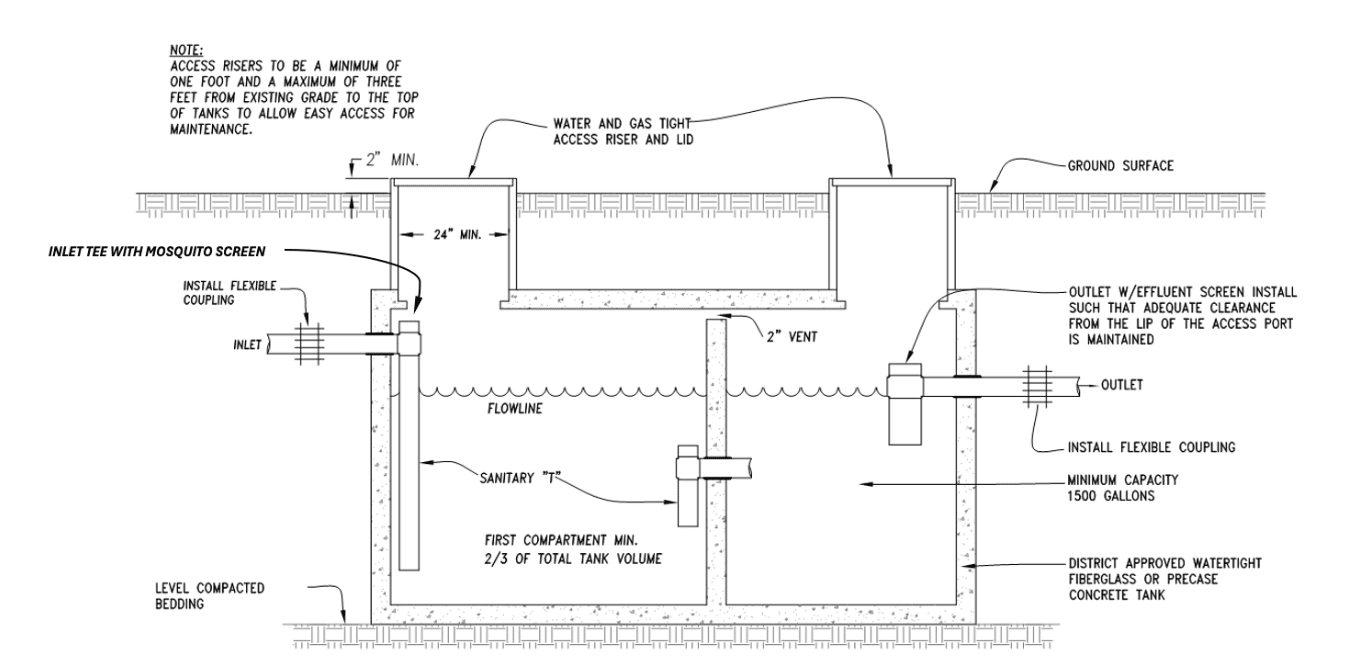
The septic tank shall be sited downgradient from all structures served such that the inflow to the septic tank shall be by gravity only, i.e. use of any intermediate lift station upstream of the septic tank shall be prohibited. Septic tank capacity shall be equal to at least three times the daily design flow volume, or 500 gallons, whichever is larger. The septic tank shall be constructed with two compartments separated by an integral wall. The inlet compartment shall be twice the capacity of the outlet compartment.
The septic tank shall be watertight and be constructed of reinforced concrete, fiberglass, plastic or other durable, non-corrodible synthetic materials approved by the General Manager. Metal and wooden tanks shall not be permitted. The tank shall be capable of withstanding anticipated structural loads and the tank top shall be capable of supporting an earth load of not less than 300 pounds per square foot. Tanks subject to traffic load shall be H-20 rated. The minimum compressive strength of any concrete tank wall, top and covers, or floor shall be 2,500 pounds per square inch.
Tanks made of fiberglass, plastic or other durable, non-corrodible synthetic materials shall not be installed within any area where groundwater depth is less than 84-inches from existing grade unless approved through a Variance per Chapter 4.08 of this Code, and only if designed with adequate anti-buoyancy measures.
Waterproof risers with gastight lids and seals shall extend from each tank compartment to 2 inches above finished grade, unless tank is set in a paved or compacted gravel/crushed rock parking or traffic area in which the riser lid(s) shall be set at finished grade. The riser shall be constructed of durable materials and be at least 24 inches in diameter to cover the tank opening. Access risers and lids in areas subject to traffic loading shall be H-20 traffic rated. Unless approved by the General Manager for use with a traffic rated tank, tank lids shall not weigh more than 25 pounds and shall be securely fastened to the riser.
Mosquito screening shall be securely affixed to the inlet tee and a District approved effluent filter shall be installed in the outlet of the septic tank. The effluent filter shall meet NSF/ANSI Standard 46.
No buildings, structures, propane/natural gas tanks, foundations/slabs/piers/footers, walls, fencing, gates, trees, woody shrubs, or parking (except as noted in Chapter 4.12 of this Code) shall be allowed over or on septic tank(s). All plumbing connections from building(s) to tank shall be made in accordance with the most recent edition of the CPC.
4.14.110 Grease Interceptor Design
Grease Interceptors shall be required for all commercial or industrial facilities that have the potential to produce fats, oils, and grease at a concentration of more than 50 mg/L, and/or generates greater than 200 gpd of waste, or as otherwise directed by the District. Grease Interceptors shall be designed using the following criteria:
Size (in gal) = (S) x (WW) x (ST) x (H) x (LF)
where:
S = Number of seats in dining area
WW = Wastewater per meal in gallons (5 gallons is normal)
ST = Storage Capacity factor of 2.5
H = Number of hours in operation of the facility
LF = Loading Factor of 1.25
Grease Interceptors shall be sufficiently sized and dimensioned to reduce wastewater temperature to allow for grease solidification and detention within the tank.
The Grease Interceptor shall be constructed of reinforced concrete, fiberglass, plastic or other durable, non-corrodible synthetic materials approved by the General Manager. Metal and wooden tanks shall not be permitted. The tank shall be capable of withstanding anticipated structural loads. The tank top shall be capable of supporting an earth load of not less than 300 pounds per square foot when maximum coverage does not exceed 3 feet. Tanks subject to traffic load shall be H-20 rated. The minimum compressive strength of any concrete tank wall, top and covers, or floor shall be 2,500 pounds per square inch.
Tanks made of fiberglass, plastic or other durable, non-corrodible synthetic materials shall not be installed within any area where groundwater depth is less than 84-inches from existing grade unless approved through a Variance per Chapter 4.08 of this Code, and only if designed with adequate anti-buoyancy measures.
Waterproof risers with gastight lids and seals shall extend from each tank compartment to 2 inches above finished grade, unless tank is set in a paved or compacted gravel/crushed rock parking or traffic area in which the riser lid(s) shall be set at finished grade. The riser shall be constructed of durable materials and be at least 24 inches in diameter to cover the tank opening. Access risers and lids in areas subject to traffic loading shall be H-20 traffic rated. Unless approved by the General Manager for use with a traffic rated tank, tank lids shall not weigh more than 25 pounds and shall be securely fastened to the riser.
No buildings, structures, propane/natural gas tanks, foundations/slabs/piers/footers, walls, fencing, gates, trees, woody shrubs, or parking (except as noted in Chapter 4.12 of this Code) shall be allowed over or on Grease Interceptor(s). All plumbing connections from building(s) to tank shall be made in accordance with the most recent edition of the CPC. Wastewater from dishwasher sinks and other plumbing fixtures shall be plumbed separately from other plumbing fixtures into the Grease Interceptor and then to the septic tank.
All Grease Interceptors shall maintain efficient operation by periodic removal of the accumulated grease. No such collected grease shall be introduced into any drainage piping or OWTS.
4.14.120 Pump/Recirculation Tank Design
The pump/recirculation tank capacity shall be equal to at least two times the daily design flow volume or 500 gallons, whichever is larger, and be constructed of reinforced concrete, fiberglass, plastic or other durable, non-corrodible synthetic materials approved by the General Manager. Metal and wooden tanks shall not be permitted. The tank shall be capable of withstanding anticipated structural loads. The tank top shall be capable of supporting an earth load of not less than 300 pounds per square foot when maximum coverage does not exceed 3 feet. Tanks subject to traffic load shall be H-20 rated. All pipes and/or electrical conduits through the pump/recirculation tank shall be either precast into the pump/recirculation tank or sealed with gas-tight compression connectors.
Tanks made of fiberglass, plastic or other durable, non-corrodible synthetic materials shall not be installed within any area where groundwater depth is less than 84-inches from existing grade unless approved through a Variance per Chapter 4.08 of this Code, and only if designed with adequate anti-buoyancy measures.
Waterproof risers with gastight lids and seals shall extend from each tank compartment to 2 inches above finished grade, unless tank is set in a paved or compacted gravel/crushed rock parking or traffic area in which the riser lid(s) shall be set at finished grade. The riser shall be constructed of durable materials and be at least 24 inches in diameter to cover the tank opening. Access risers and lids in areas subject to traffic loading shall be H-20 traffic rated. Unless approved by the General Manager for use with a traffic rated tank, tank lids shall not weigh more than 25 pounds and shall be securely fastened to the riser.
No buildings, structures, propane/natural gas tanks, foundations/slabs/piers/footers, walls, fencing, gates, trees, woody shrubs, or parking (except as noted in Chapter 4.12 of this Code) shall be allowed over or on a pump/recirculation tank(s). All plumbing connections from buildings to tank shall be made in accordance with the most recent edition of the CPC. The pumping system shall be compatible for use with sewage and be capable of delivering the design volume of effluent based upon the design head. The minimum pump inlet shall be at least 4 inches or per the pump manufacturer’s recommendation, whichever is greater.
4.14.200 Standard Pretreatment Systems
A standard pretreatment system shall consist of either a recirculating textile filter, or a recirculating sand filter installed prior to discharge into the dispersal fields. A pretreatment system shall be required for all OWTS designs where the average percolation rate is faster than 10 min/in, and/or where any proposed dispersal fields are located either partially or fully under a driveway, parking area, or other paved/unpaved vehicular traffic area.
4.14.210 Recirculating Textile Filter Pretreatment Design
All RTFs shall be Orenco Systems AdvanTex, or equal, preceded by a septic tank with an effluent filter, and sized for the design flow. The number of RTF units required for each system shall be based upon the design flow, effluent strength, and the manufacturer’s specifications. The installer shall be trained and certified by the manufacturer.
Filtered septic tank effluent shall be applied to the RTF by pressure dosing, utilizing a pumped recirculation system. The pressured system shall be designed in accordance with accepted engineering practices to achieve adequate flow rate, screening of effluent and suitable piping network to preclude solids accumulation in the pipes or clogging of discharge orifices The RTF shall be fitted with a recirculating pump and splitter valve set for a recirculation rate of 4:1 at design flow conditions achieved by timed dosing. The recirculation pump shall be sized to allow RTF effluent to be applied directly to the dispersal fields. Appropriate effluent screening shall also be utilized to preclude solids accumulation in the pipe network, or clogging of discharge orifices.
RTF system control panels shall be designed and equipped with a control panel as specified in Section 4.14.500 of this Code and in such a manner that if the RTF system should cease to function properly, the alarm system will activate, and both the recirculation pump and the dosing pump will automatically deactivate. The RTF system control panel shall also be equipped for remote data acquisition via telemetry through an active internet connection provided by the Owner.
4.14.220 Recirculating Sand Filter Pretreatment Design
Filtered septic tank effluent shall be applied to the RSF by pressure dosing, utilizing a pump/recirculation tank fitted with a recirculating pump and splitter valve sized for the design flow and set with a recirculation rate of 5:1. Dosing shall be timed at a minimum of every 30 minutes. Appropriate effluent screening shall also be utilized to preclude solids accumulation in the pipe network, or clogging of discharge orifices.
No buildings, structures, propane/natural gas tanks, foundations/slabs/piers/footers, walls, fencing, gates, fountains/bird baths (or similar), statues/art pieces (or similar), decking, hardpan, boulders, concrete or stone pavers, trees, woody shrubs, parking, or vehicular traffic shall be allowed on or over any RSF. All air vents, monitoring wells and valve boxes shall remain uncovered, clear and easily accessible at all times.
Recirculation pump and controls shall be designed to dose a constant volume of mixed filtrate and septic tank effluent flow onto the filter on a timed cycle. The pump shall be sized to provide the necessary dosing rate at the operating discharge head required by the distribution system.
A redundant pump-off float switch shall be installed in the pump/recirculation tank below the minimum dose volume level.
RSF system control panels shall be designed and equipped in such a manner that if the RSF system should cease to function properly, the alarm system will activate, and both the recirculation pump and the dosing pump will automatically deactivate.
- RSF units shall be designed using the following criteria:
- Retaining wall shall consist of marine-grade, pressure treated or redwood soldier piles and lagging, with piles and lagging adequately sized and spaced to fully support the soil and hydrostatic loads without sagging or bulging. In lieu of soldier piles and lagging, formed reinforced concrete walls designed to fully withstand the anticipated soil and hydrostatic loads are acceptable.
- A District-approved waterproof liner having a minimum thickness of 30 millimeters that is completely sealed and double-layered, and completely free of all tears and holes shall be installed along the interior sides and bottom of the RSF. Cover over distribution bed shall be native soil and depth shall not exceed 12 inches.
- Distribution bed gravel shall be ¼ to ¾ inch double-washed pea gravel free of fines and shall extend 3 inches above and 6 inches below the distribution piping.
- The distribution bed piping shall be Schedule 40 PVC sized so that there is no more than a 2% differential in discharge head with head loss calculations based upon the methodology presented with the design submittals. The pipe shall be laid flat with orifices pointing upward and shall be pressure tested to ensure the integrity of all joints, the orifice shall be minimum 1/8 inches in diameter, and orifice shields shall be provided. To provide for more effective utilization of sand bed, orifices shall be spaced on average so that there is four square feet of bed per orifice. A District approved valve shall be provided to alternately dose at least two sections of the bed. Orifices shall be pre-drilled on a drill press or other District approved alternative.
- The filter bed media shall be a minimum of 24 inches deep and shall consist of durable washed sand meeting the following criteria, or as approved by the General Manager:
Sieve Size % Pass #4 100 #8 70-90 #18 40-60 #30 25-35 #50 2-5 #60 0 D10>0.400mm, D60=1.4mm, UC =3.0-4.0
- Filter bed media shall be analyzed by wet-sieve analysis using ASTM C-117, or equivalent. Prior to placement of filter media, the District shall be provided with a certified copy of the conforming sieve analysis. Organic loading shall be ≤ 5 lb BOD5/1,000 sf per day.
- Pea gravel in the underdrain bed shall be ¼ to ¾ inch clean, double-washed, and free of fines and at a depth of least 8 inches.
- Underdrain piping shall be 4 inch Schedule 40 PVC with slots of 1/16 to 1/8 inch width, ¼ inch on center laid at 0 – 0.1% slope.
- Below the RSF floor liner shall be level and compacted sand bedding, free of rock and pebbles, 4 inches deep, above level and compacted native soil. Bottom of RSF shall maintain a minimum 3 foot separation to impermeable soils and/or seasonal high groundwater.
- Flow splitting shall be controlled by a ball float valve located in the pump/recirculation tank, or by other means as approved by the General Manager.
- The designer may include such Maintenance design features as may be considered appropriate, but at a minimum shall include:
- Means for evaluating the residual head at the terminal orifice of each lateral of the distribution bed piping.
- Means for flushing each distribution lateral to remove material blocking or which may block the orifices.
- An air vent for each underdrain lateral network.
- Means for flushing each underdrain lateral to remove material blocking or which may block the orifices.
- Means to clean the effluent screen.
4.14.300 Standard Trench Dispersal Field Design
All standard trench dispersal fields shall be pressure dosed and have a minimum of two fields, each containing 100% of the required absorption area. A diversion valve shall be installed to divert flow from one dispersal field to the other, as specified herein.
Irrigation and/or any concentrated surface drainage from buildings, yards, drives, etc., as well as subsurface drainage shall be diverted away from the dispersal field area. This may require site grading and installation of a diversion ditch, interceptor drain, or berm on the upslope side of the dispersal field area.
No buildings, structures, propane/natural gas tanks, foundations/slabs/piers/footers, walls, fencing, gates, planters/raised gardens (or similar), fountains/bird baths (or similar), statues/art pieces (or similar), decking, hardpan, boulders, concrete or stone pavers, trees of any size or variety, woody shrubs of any size or variety, or parking (except as noted in Chapter 4.12 of this Code) shall be allowed over or in any dispersal field areas. All monitoring wells and valve boxes shall be free from groundcover or landscaping, clear and easily accessible at all times.
Trenches shall be placed on contour with no more than 3 inches of drop in 100 feet. No single trench shall be more than 100 feet in length. Layout shall maximize the spreading of effluent in the dispersal field area.
- Maximum total depth shall be 8 feet. Minimum effective dispersal field depth shall be 12 inches.
- Depth of the trench is determined in part by the depth of the percolation test depths. The bottom of trench shall maintain a 3 foot separation to impermeable soils and seasonal high groundwater.
- Minimum trench width shall be 18 inches; maximum trench width shall be 36 inches.
- Minimum spacing between trench walls shall be calculated as twice the effective trench depth plus an additional foot for each 5% dispersal field area slope over 20%. In no case shall the trench spacing (center-to-center) be less than 6 feet.
- The effective sidewall area is measured from below the perforated lateral to the bottom of the trench or the louvered sidewall area of the chamber. The minimum effective sidewall depth shall be 12 inches.
Geotextile fabric is required between the gravel and cover in the dispersal lines to reduce the migration of fines into the gravel of the trenches.
Geotextile fabric is required between the gravel and cover in the dispersal lines to reduce the migration of fines into the gravel of the trenches.
Gravity flow systems are prohibited. Pressure distribution system piping shall be at least Schedule 40 PVC with a minimum internal diameter of 1¼ inches. Systems with upward facing holes shall incorporate individual orifice shields. The system design shall provide some means of equalizing the volumetric dose applied to each trench in accordance with engineering practices. Gate valves shall be used to set orifice squirt height in laterals. Once system flow is balanced, all gate valve handles shall be removed and left in their respective valve box to discourage unintended operation. Purge valves shall be installed at the end of each dispersal field line. All valves shall be housed in a box that terminates above grade and is accessible for inspection with a lid permanently marked “septic” or “sewer”.
Drain rock or pea gravel shall be clean, durable ¾ to 1½ inch rock free of fines. A minimum cover dimension from ground surface to the top of the drain rock shall be as follows:
| Dispersal Field Slope | Cover Requirement (in) |
|---|---|
| 0-15% | 12 |
| 16-20% | 15 |
| 21-30% | 18(1) or 21(2) |
| 31-40% | 24(1) or 30(2) |
| >40% | 30(1) or 36(2) |
Notes:
- For Soil Class I or II
- For Soil Class III or IV
Dispersal fields shall be designed based on the average percolation rate of all percolation testing performed as specified in Chapter 4.12 of this Code. Any percolation rates faster than 1 min/in or slower than 120 min/in shall not be included when calculating the average percolation rate.

4.14.310 Standard Trench Dispersal Field Cover Fill
Where soil and/or groundwater conditions require shallow trench placement, soil fill may be used to satisfy dispersal field cover requirements, subject to:
- The fill shall be continuous, constructed to a uniform depth over the dispersal fields, extend a minimum distance of 15 feet in any direction from the center of any trench, and shall be completed with a toe tapered at no less than a 5:1 ratio.
- The percolation rate shall not be slower than 60 minutes per inch.
- The drain rock and perforated pipe sections shall be installed entirely within native soil.
- Prior to placement of fill material, all vegetation shall be removed and the ground surface plowed to permit good mixing of native soil and fill material.
- Gravel or rock may not be used for cover fill. The soil used for fill shall be similar in texture to the native soil.
- Fill shall be placed in layers of not more than eight inches and compacted to approximately the same dry density as the native soil. Alternative compaction procedures may be allowed in accordance with recommendations and technical data supplied by a Designer.
4.14.320 Standard Raised Bed Dispersal Field Design
A standard raised bed dispersal field may be used to obtain the required depth-to-groundwater in a system which utilizes a District-approved pretreatment design. All standard raised bed dispersal fields shall be pressure dosed and have a minimum of two fields, each containing 100% of the required absorption area. A diversion valve shall be installed to divert flow from one dispersal field to the other, as specified herein.
Irrigation and/or any concentrated surface drainage from buildings, yards, drives, etc., as well as subsurface drainage shall be diverted away from the dispersal field area. This may require site grading and installation of a diversion ditch, interceptor drain, or berm on the upslope side of the dispersal field area.
No buildings, structures, propane/natural gas tanks, foundations/slabs/piers/footers, walls, fencing, gates, planters/raised gardens (or similar), fountains/bird baths (or similar), statues/art pieces (or similar), decking, hardpan, boulders, concrete or stone pavers, trees of any size or variety, woody shrubs of any size or variety, or parking (except as noted in Chapter 4.12 of this Code) shall be allowed over or in any dispersal field areas. All monitoring wells and valve boxes shall be free from groundcover or landscaping, clear and easily accessible at all times.
All raised bed dispersal fields and shall be subject to the following design standards:
- The maximum allowable ground slope shall be 20%.
- Retaining wall shall consist of marine-grade, pressure treated or redwood soldier piles and lagging, with piles and lagging adequately sized and spaced to fully support the soil and hydrostatic loads without sagging or bulging. In lieu of soldier piles and lagging, formed reinforced concrete walls designed to fully withstand the anticipated soil and hydrostatic loads are acceptable.
- A District-approved waterproof liner having a minimum thickness of 30 millimeters that is completely sealed and double-layered, and completely free of all tears and holes shall be installed along the interior sides of the raised bed dispersal field and shall extend to below the footing of the retaining walls.
- The distribution bed shall consist of 3/8-inch pea gravel or District approved equivalent, free of fines. The pea gravel shall extend a minimum of 6 inches below the invert and 2 inches above the top of distribution lateral.
- The bottom of the distribution bed shall be level; and the downslope side shall be parallel to the slope contour.
- The gravel distribution bed shall be covered in its entirety with a geotextile silt barrier. Geotextile shall be either polyester, nylon or polypropylene, or any combination thereof, and shall be suitable for underdrain application. Geotextile shall be non-woven, shall not act as a wicking agent and shall be permeable.
- 12-inch minimum to 18-inch maximum soil cover shall be placed over the geotextile. The soil cover shall consist of medium, loamy-textured soil or District approved equivalent.
- Up to 12 inches of imported sandy soil may be utilized to meet the three feet of vertical separation. The sandy soil shall meet the following sieve size criteria as analyzed by wet-sieve analysis using ASTM C-117, or equivalent.
Sieve Size % Pass #4 100 #8 70-90 #18 40-60 #30 25-35 #50 2-5 #60 0 D10>0.400mm, D60=1.4mm, UC =3.0-4.0
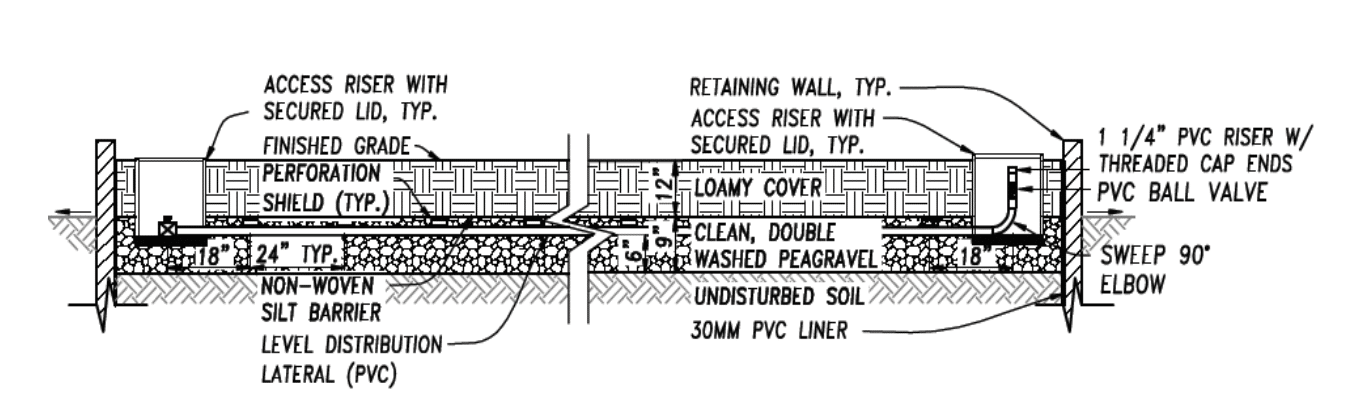

4.14.330 Diversion Valve
All dual dispersal field systems shall be provided with a pressure-rated PVC diversion valve. The valve shall be housed in a box that terminates above grade and is accessible for inspection with a lid permanently marked “septic” or “sanitary”. Diversion valves shall be operated to divert flow to the opposite dispersal field every six months.
4.14.340 Pressure Piping
Pressure pipe from the pump/recirculation tank to the dispersal field shall be a minimum Schedule 40 PVC and sized to meet pumping and effluent flow requirements while minimizing frictional losses. Starting at the pump installation, a union, a swing check valve, and a double wedge gate valve shall be installed. These items are required either in the pump/recirculation tank or in a concrete vault adjacent to the pump/recirculation tank.
4.14.350 Thrust Blocks
Concrete thrust blocks are required on all pressure piping at all bends greater than 45 degrees.
4.14.360 Monitoring Wells
All dispersal fields are required to have two monitoring wells, one in each field, located at the ends of the trench and installed to the depth of the trench. Monitoring wells shall include a 12-inch-deep seal of concrete or bentonite to preclude surface water infiltration to the trench. The monitoring well shall have slotted or drilled holes within the effective sidewall area.
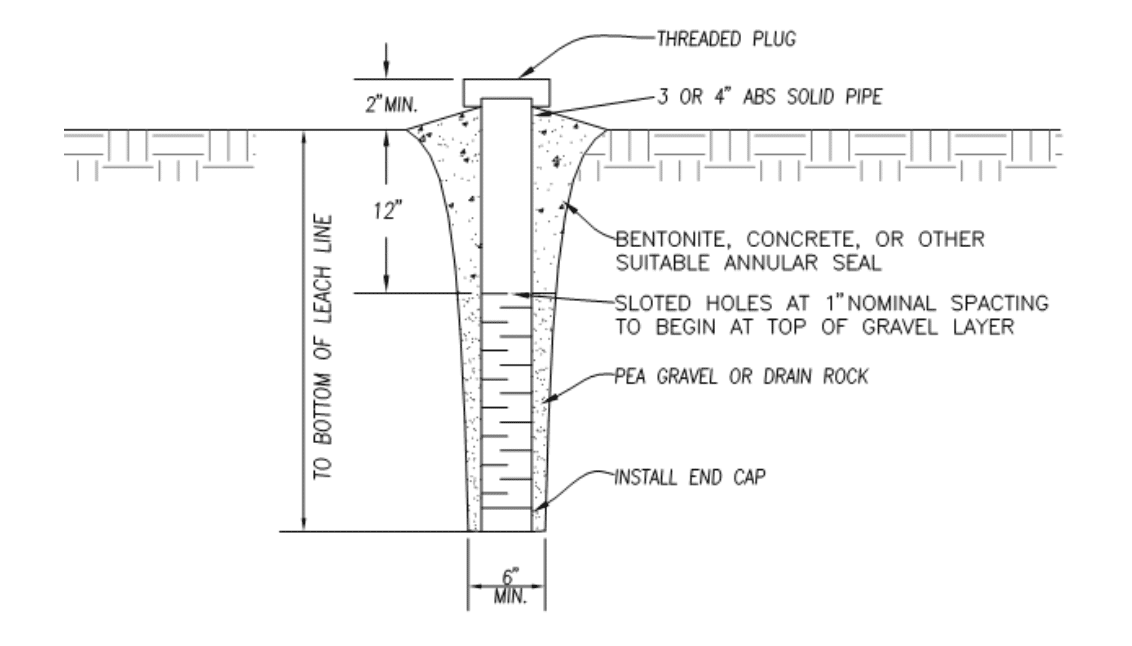
4.14.400 Interceptor Drain
The use of intercept drains to lower the level of perched groundwater in the immediate dispersal field area shall be acceptable under the following conditions:
- Natural ground slope is greater than 5%.
- Site investigations show groundwater to be perched on a clearly definable layer of bedrock, hardpan, or impermeable soil.
- The intercept drain shall be installed on the upslope side of the dispersal field area.
- The intercept drain shall be a minimum of 12 inches wide and shall extend from the ground surface into bedrock, hardpan, or the impermeable soil layer a minimum of 6 inches and a maximum of 96 inches, provided no hardpan or impermeable soil is encountered.
- The bottom and downslope side of the intercept drain shall be lined with plastic film having a minimum thickness of 12 millimeters.
- The drainage trench shall be filled with ¾ to 1½ inch drain rock, with perforated 4 inch drainpipe along and 2 inches above the bottom of the trench.
- Geotextile or other suitable filter material shall be placed immediately above the drain rock.
4.14.500 Telemetry Control Panel
All tanks containing pumps shall include a NEMA Type 4X IP66 (or District approved equivalent) telemetry control panel utilizing the Vericomm network. The telemetry control panel shall be equipped for both local and remote supervisory data acquisition and control, and shall have an active internet connection provided by the Owner. If multiple pump/recirculation tanks are utilized, all controls may be housed in the same control panel. The control panel shall be located within 30 feet and within direct view of the pump/recirculation tank; shall be mounted on the building served, pipe stand, or wooden post(s); and at a minimum, shall contain:
- An Automatic On / Off / Manual toggle switch; and
- A fused disconnect and motor protection switch; and
- Programmable controls to automatically control pump dosing cycles with an elapsed time meter and a dose counter; and
- Data recordation for pump activation and run duration; and
- Controls for the solenoid discharge valves to each dispersal field; and
- Data recordable visual and audible (80 dB minimum) alarm, with silencer, to provide warning that water level in the pump/recirculation tank is in the capacity reserved for emergency storage.
Separate conduits shall be provided for control wire and power supply. Separate circuits with individual breakers at the main panel shall be provided for the control panel/alarm and pump. Float switches (non-mercury) shall be anchored to a suitable float tree for controlling the starting and stopping of pump and high-level alarm operations. All conduits shall be sealed and be both water and gas tight.
Chapter 4.16: ALTERNATIVE SYSTEM DESIGN
4.16.010 Use of Alternative Wastewater System Designs
Any OWTS design that does not conform to the provisions of Chapter 4.14 of this Code shall be considered an Alternative System. All Alternative Systems shall be designed to meet the influent and effluent water quality parameters as specified in Chapter 4.14 of this Code, be NSF approved, and shall be subject to design review and approval by the General Manager before consideration by the Board. The District shall not approve the use of an Alternative System unless existing site conditions explicitly prohibit the use of a Standard System. Use of an Alternative System shall require a Variance subject to Chapter 4.08 of this Code
4.16.020 Telemetry Control Panel
All tanks containing pumps shall include a NEMA Type 4X IP66 (or District approved equivalent) telemetry control panel using the Vericomm network. The telemetry control panel shall be equipped for both local and remote supervisory data acquisition and control, and shall have an active internet connection provided by the Owner. If multiple pump/recirculation tanks are utilized, all controls may be housed in the same control panel. The control panel shall be located within 30 feet and within direct view of the pump/recirculation tank; shall be mounted on the building served, pipe stand, or wooden post(s); and at a minimum, shall contain:
- An Automatic On / Off / Manual toggle switch; and
- A fused disconnect and motor protection switch; and
- Programmable controls to automatically flush both the dispersal fields and effluent filter; and
- Programmable controls to automatically control pump dosing cycles with an elapsed time meter and a dose counter; and
- Data recordation for pump activation and run duration; and
- Controls for the solenoid discharge valves to each dispersal field; and
- Data recordable visual and audible (80 dB minimum) alarm, with silencer, to provide warning that water level in the pump/recirculation tank is in the capacity reserved for emergency storage.
Separate conduits shall be provided for control wire and power supply. Separate circuits with individual breakers at the main panel shall be provided for the control panel/alarm and pump. Float switches (non-mercury) shall be anchored to a suitable float tree for controlling the starting and stopping of pump and high-level alarm operations. All conduits shall be sealed and be both water and gas tight.
Chapter 4.18: HOLDING TANKS
4.18.010 Use of Holding Tanks
No person shall use any temporary or permanent tank for holding Wastewater except:
- For temporary use during New OWTS Construction, as determined by the General Manager; or
- In the case where all other options for a replacement OWTS have been considered by the applicant and a permanent holding tank is the only remaining feasible option, a Variance request per Chapter 4.08 of this Code shall be required.
- Use of a permanent holding tank for New OWTS Construction on a newly developed property shall not be allowed.
4.18.020 Holding Tank Compliance
All holding tanks shall comply with the following:
- Issuance of a permit and payment of prescribed holding tank fees. The holding tank permit fee may be periodically collected and may be charged on a unified water service bill.
- Submittal of documents verifying that the required pumping has been completed by a person licensed by the County of Marin pursuant to Section 25000 et seq. of the Health and Safety Code.
- Installation of an audio/visual alarm within 20 feet of the holding tank; to be activated when the tank is within 85% of total capacity at which point the owner shall have the tank pumped out.
4.18.100 Holding Tank Design Standards
All holding tanks shall meet all the following design standards:
- The tank capacity shall be equal to three times the daily design flow volume or 1,500 gallons, whichever is larger.
- The holding tank shall be constructed of reinforced concrete, fiberglass or other durable, non-corrodible synthetic materials approved by the General Manager. Metal and wooden tanks shall not be permitted. The tank shall be capable of withstanding anticipated structural loads. The tank top shall be capable of supporting an earth load of not less than 300 pounds per square foot when maximum coverage does not exceed 3 feet. Tanks subject to traffic load shall be H-20 rated. The minimum compressive strength of any concrete tank wall, top and covers, or floor shall be 2,500 pounds per square inch. Unless approved by the General Manager on a case-by-case basis, fiberglass and plastic tanks shall not be installed within the lowland areas subject to high groundwater elevations.
- Waterproof riser with gastight lid and seal shall extend from the holding tank to 2 inches above finished grade. The riser shall be constructed of durable materials and be at least 24 inches in diameter to cover the tank opening. Access risers and lids in areas subject to traffic loading shall be H-20 traffic rated. Unless approved by the General Manager for use with a traffic rated tank, tank lids shall not weigh more than 25 pounds and shall be securely fastened to the riser.
- No buildings, structures, propane/natural gas tanks, foundations/slabs/piers/footers, walls, fencing, gates, trees, woody shrubs, or parking (except as noted in Chapter 4.12 of this Code) shall be allowed over or on holding tank. All plumbing connections from building to the holding tank shall be made in accordance with the most recent edition of the CPC.
- The holding tank shall be vented as required in Chapter 9 of the CBC and fitted with securely affixed mosquito screening.
- Holding tanks shall be installed level on a solid bed and in no case shall the depth be greater than the manufacturer’s limits of cover. Soil around the tank shall be hard-compacted or jetted.